


Need A Lift? Most days, you probably do if you work in an extended care facility or assisted living environment, especially if you are helping people with mobility issues to transfer or perform other motions.
If that’s the case, you do need a lift, so you don’t hurt them or yourself.
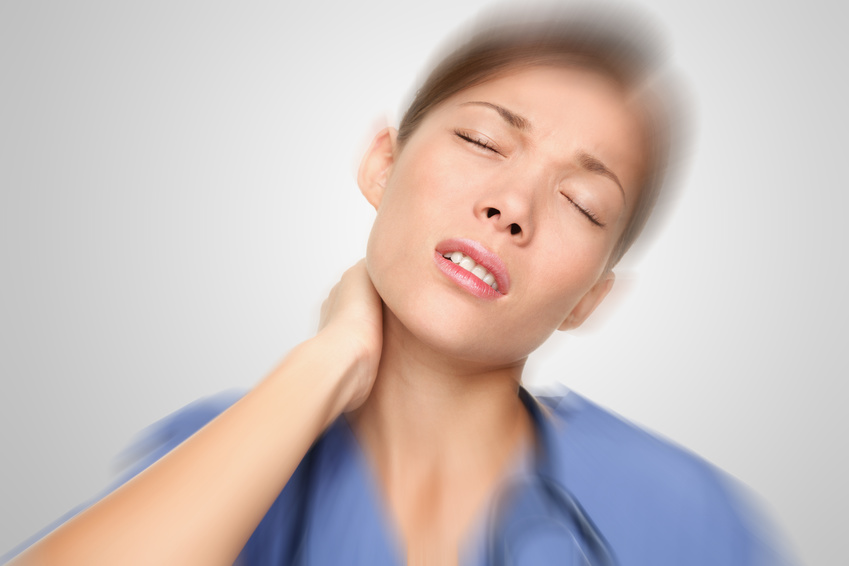
According to the US Department of Labor, one major source of injury to healthcare workers is musculoskeletal disorders (MSDs). In 2010, nursing aides, orderlies, and attendants had the highest rates of MSDs. These injuries are due in large part to overexertion as a result of repeated manual patient handling activities.
Safety First: Patient Lifting
Some examples of patient handling tasks that may be identified as high-risk include:
- transferring from toilet to chair,
- transferring from chair to bed,
- transferring from bathtub to chair, and
- lifting a patient from the bed.
The American Nurses Association calls for the elimination of manual patient handling, because it is unsafe and causes musculoskeletal injuries to nurses and may cause injury to residents.
OSHA recommends that manual lifting of residents be minimized in all cases and eliminated whenever feasible.
The mandated use of mechanical lifting equipment can significantly affect injury data, financial outcomes, and employee satisfaction. Along with higher employer costs due to medical expenses, disability compensation, and litigation, nurse injuries also are costly in terms of chronic pain and functional disability, absenteeism, and turnover.

Direct and indirect costs in the healthcare industry associated with back injuries alone are estimated to be $20 billion annually. In addition, healthcare employees who experience pain and fatigue may be less productive, less attentive, more susceptible to further injury, and more likely to affect the health and safety of others.
Another factor is the national epidemic of morbid obesity.
Patients are becoming increasingly older and heavier and more at risk for having numerous chronic health conditions. This increases the demand on our healthcare system, as older patients require more assistance with the activities of daily living.

Give a lift to your employees who are at risk for injury.
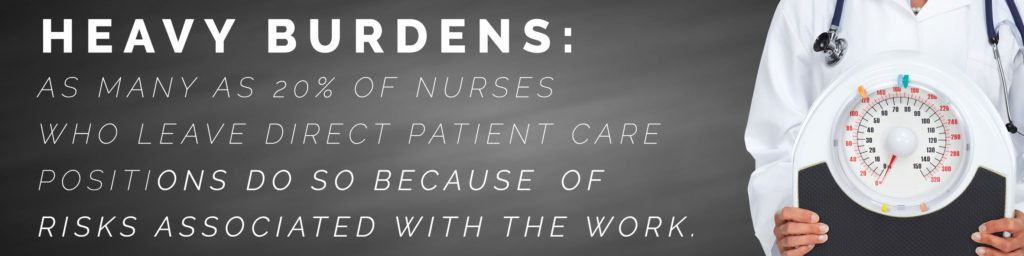
Our workforce is also aging. Important considerations for employee recruitment and retention strategies are: wages, benefits, and the amount of heavy physical work. As many as 20% of nurses who leave direct patient care positions do so because of risks associated with the work.
Safety First: The Advantages of Using a Lift
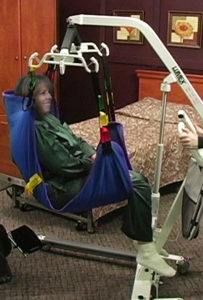
Using assistive patient handling equipment may take longer than manual lifting, but the benefits far outweigh this time difference for both the caregiver and the patient. Explaining planned lifting procedures to patients prior to lifting and enlisting their cooperation and engagement can increase patient safety and comfort, and enhance their sense of dignity.
Industries where patient handling tasks are performed include:
- Long Term Care (includes facilities that provide skilled or non-skilled nursing care);
- Acute Care (includes hospitals, out-patient surgical centers, and clinics); and
- Home Healthcare workers
Some examples of facility areas that may be identified as high-risk include:
- bathing rooms,
- extended care wings, and
- diagnostic units (e.g., radiology, emergency department, spinal unit, orthopedics department).
Patient transfer and lifting devices are key components of an effective program to control the risk of injury to patients and staff.
The education and training of healthcare employees associated with lifting, transferring, repositioning or movement of patients should be geared toward:
- assessment of hazards in the healthcare work setting,
- selection and use of the appropriate patient lifting equipment and devices, and
- review of research-based practices of safe patient handling.

Let Graham-Field Give You a Lift!
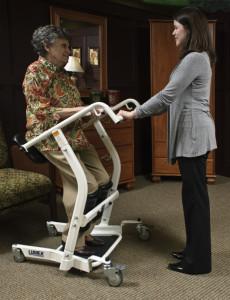
Graham-Field offers a full line of floor lifts and sit-to-stand patient lifts and slings for your lifting programs. LUMEX lifts are shipped with a ‘how-to’ video to help with training new staff.
See our LF1050 and LF1090 floor lifts and LF2020, LF2090, and LF1600 sit-to-stand lifts, and learn how these safety products can help you daily as a care provider.
In addition, GF manufactures their full-body slings in their ISO approved cut and sew facility in Doraville, GA. The slings are available in solid and mesh fabrics. Graham-Field realizes the importance of providing a safe sling with consistent quality – each and every time!
Safety FIRST! Patient Safety, Employee Safety.
Contact us for more ideas and advice.
Nancy Prossick is Marketing Manager, Extended Care at Graham-Field.