





Theft happens! It cannot be completely avoided; unfortunately, it WILL occur. Theft is a fact of life for healthcare institutions, from gloves … to ultrasound machines … to wheelchairs.
It’s almost like the wild, wild west out there when it comes to inventory control.

People can get prickly when you implement a theft prevention process. Don’t let that faze you from doing it!
Hospitals must manage wheelchair and mobility device theft more often with protocol than technology.
Use some of the following strategies to help prevent theft in your hospital:
1. Supply chain control
Maintain only that inventory that needs to be available for immediate use. For example, you could require that wheelchairs remain boxed until they are needed, or keep only a limited number accessible to employees. Upholstery color could also be used as a product cycling or inventory control method.
2. Anti-theft device installation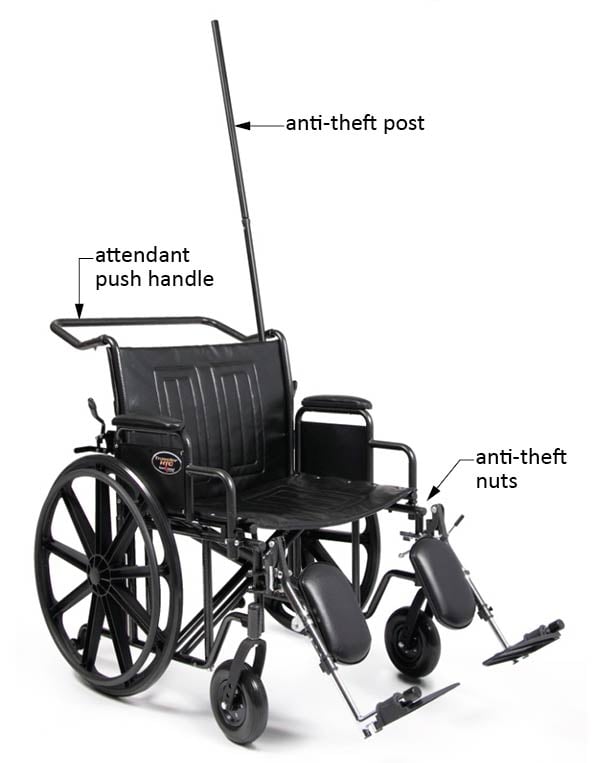
- Anti-theft post: This device, so tall it cannot go through most doors, can help prevent wheelchair removal. However, some hospitals find this accessory interferes with IV poles or other attachments, so it may not be practical everywhere.
- Front rigging anti-theft nuts: Anti-theft nuts secure front rigging, preventing users from removing or misplacing it. These could prevent the removal of front rigging.Several Everest & Jennings wheelchair models also offer fixed, non-removable front rigging which may be practical in places where there is likely to be front rigging theft.
- Anti-fold bar: An anti-fold bar prevents the wheelchair from folding, making theft much more difficult, since a wheelchair cannot be quickly folded and stashed in a getaway car. Hospitals have used wheelchair anti-folding measures for many years.
- Graham-Field’s Everest & Jennings® brand offers a Hospital Transport wheelchair, the Traveler® HTC, (shown at right) that includes all these features without having to order each separately: the Traveler HTC features an anti-theft pole, a fixed attendant push handle that acts as an anti-fold device, fixed, non-removable anti-tippers and arms, and front-rigging anti-theft nuts, as well as other convenient features.
3. Escort/Transportation Department protocol
Since these departments are the ones using facility wheelchairs the most, They should maintain control of traffic record-keeping.
4. Assure all wheelchairs are quickly identifiable
This could be upholstery color or a logo design on the back. The Everest & Jennings brand offers a Custom Color Upholstery program to provide an immediate visual check that a wheelchair is in the appropriate place.
5. Surveillance system installation and monitoring
All-time cameras, motion sensors, RFID, etc. — though not all hospitals have developed RFID systems, the ones who have still faced the problem of being unable to act quickly enough to catch the thief. Such a system allows traceability and could serve as the early detection of a flaw in wheelchair allocation systems.
6. Accurate medical device record-keeping — especially if it has wheels
Every department should be responsible for its equipment, and the best way to keep track of a wheelchair is by its serial number. All Everest & Jennings wheelchairs have serial number decals, unique to each wheelchair, located on the crossbrace. This information will also help provide an accurate police report if a wheelchair is actually stolen.
7. Review and act on theft statistics
If a hospital notices that a certain facility location is robbery-prone, staff can use this information to improve systems.
8. Measure department performance, including how Hospital Employees and Staff engage with anti-theft protocol and policy
Theft is performed by people, and the best way to prevent it is with people as well. Each hospital must create protocols that embrace cost savings and ownership of the tools staff need to perform their jobs. Engage employees to achieve success in managing a problem that is inherent to the hospital workplace.
Contact us for more ideas and advice.
Maria Garcia Silva is a Product Manager/ International Marketing Manager at Graham-Field.